
October 21, 2026 · Journal
SEO Statistics for 2026: Fact Checked Data on Search, AI, CTR, Backlinks and ROI
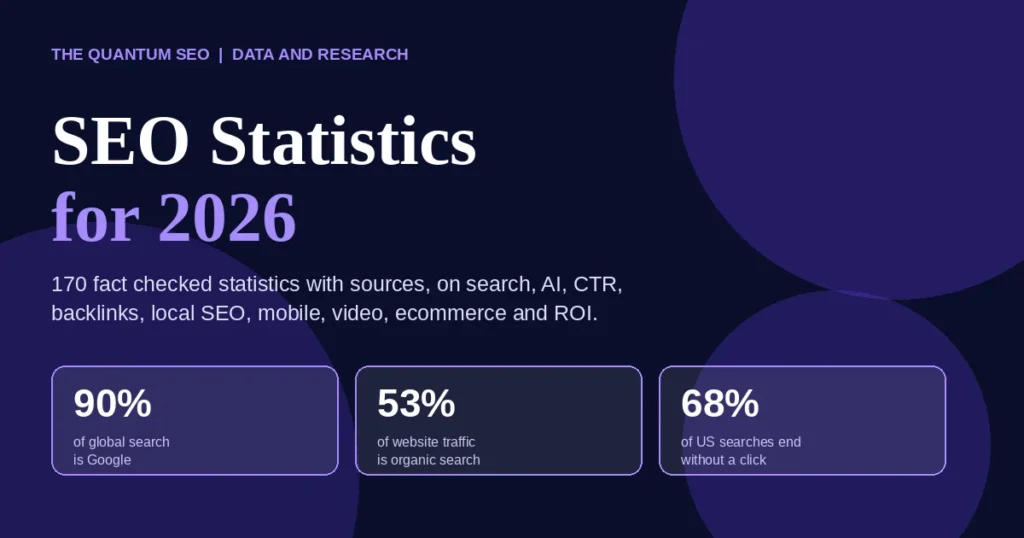
Search has not shrunk in 2026. It has spread out. People still start with Google, but they also get answers from AI Overviews, AI assistants, voice search, YouTube and local listings, and a growing share of searches now end without any click at all.
That change makes good data more valuable, not less. If you plan budgets, content and link building on old numbers, you will aim at a search landscape that no longer exists.
This guide collects the SEO statistics that matter in 2026. Every figure below names the organisation that produced it and, where the source states it, the year of the data. Where respected studies disagree with each other, we say so and explain why, instead of picking the number that sounds biggest.
How we built this list: methodology
1. Primary sources first. We favoured data published by the organisation that collected it, such as Google, StatCounter, Ahrefs, Backlinko, BrightEdge, SparkToro, Pew Research Center and the HTTP Archive.
2. No stat without a source. If a widely shared figure could not be traced to a named study, it is not in this article.
3. Dates stay visible. Search behaviour is moving fast, so a 2023 figure is labelled 2023, not dressed up as 2026 data.
4. Conflicts are shown, not hidden. Where studies report different values for the same metric, the range is given with the reason for the gap.
5. This page is reviewed monthly. New data replaces old data, and the change is recorded in the changelog at the end of the article.
Top 20 SEO statistics for 2026
| # | Statistic | Source |
| 1 | Google holds about 90% of global search market share | StatCounter, 2026 |
| 2 | Organic search drives about 53% of all website traffic | BrightEdge |
| 3 | 68% of online experiences begin with a search engine | BrightEdge |
| 4 | 68.01% of US Google searches ended without a click in early 2026 | SparkToro and Similarweb, 2026 |
| 5 | 96.55% of pages get no search traffic from Google at all | Ahrefs |
| 6 | The first organic result earns roughly 28% to 40% of clicks, depending on the study | Backlinko, Advanced Web Ranking, First Page Sage |
| 7 | The top 3 organic results collect between 54% and 69% of all clicks | Backlinko, First Page Sage |
| 8 | AI Overviews cut organic CTR by about 34.5% in one large study, and by more in later ones | Ahrefs, Seer Interactive |
| 9 | About 48% of tracked queries now trigger an AI Overview | Semrush, February 2026 |
| 10 | 87% of marketers use AI to create or help create content | Ahrefs survey, 879 respondents |
| 11 | About 74% of new web content is produced with AI assistance | Ahrefs |
| 12 | The number 1 page has about 3.8 times more backlinks than pages ranked 2 to 10 | Backlinko |
| 13 | About 95% of pages have no backlinks at all | Backlinko |
| 14 | Only about 33% of websites pass the Core Web Vitals thresholds | Ahrefs |
| 15 | Mobile devices generate about 63% of global web traffic | Statista |
| 16 | 46% of Google searches carry local intent | Moz |
| 17 | SEO leads close at 14.6%, compared with 1.7% for outbound leads | HubSpot data reported by Intergrowth |
| 18 | SEO returned about 8 times the investment in one 119 company study, against 4 times for PPC | NP Digital |
| 19 | Google processes more than 5 trillion searches a year | Google, reported by Search Engine Land |
| 20 | 15% of Google searches have never been searched before |
Why the numbers differ: read this before you quote any stat
Statistics pages often look like they contradict each other. Usually they are measuring slightly different things.
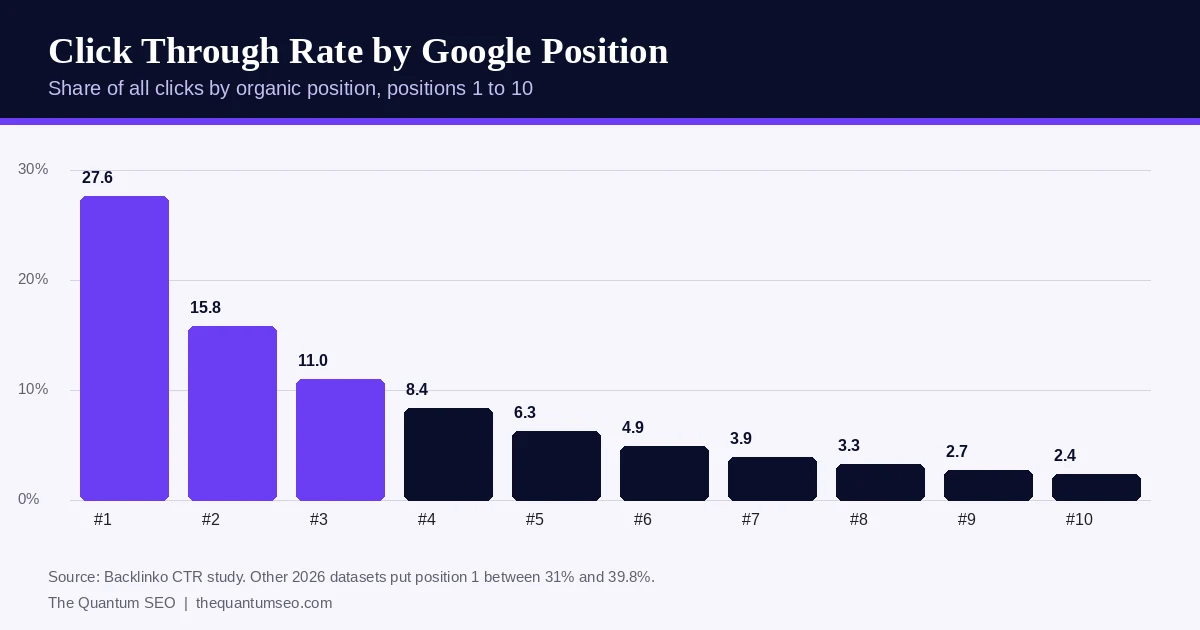
Click through rate for position 1. Studies report 27.6% (Backlinko), 31% (Advanced Web Ranking, 2026) and 39.8% (First Page Sage). The gap comes from the query mix, the device mix, the country, the year, and whether brand and navigational searches are included. The honest answer in 2026 is a range, not a single magic number.
Zero click rate. Figures range from about 27% to 68%. The lower figures usually count only searches that end the session. The higher figures also count searches where the user clicked a Google property, refined the query, or got the answer on the results page. SparkToro and Similarweb put the US figure at 68.01% for January to April 2026.
Searches per day. You will see 8.5 billion, 14 billion and 16.4 billion per day quoted in different articles. Google itself reports more than 5 trillion searches a year, which works out at roughly 14 billion a day. Treat any daily figure as an estimate built on that annual number, not as a directly measured count.
SEO market size. Estimates for 2026 range from about 84 billion dollars to more than 105 billion dollars. The difference is scope. Some reports count agency services only, while others add software, tools and in house spend.
What this means for you: always quote a stat with its source, its year and its definition. A number without those three things is marketing, not evidence.
What our own client data shows
Most statistics in this article come from large third party studies. This short section is different. These are first party results from our own client work at The Quantum SEO, taken from Google Search Console.
1. One client property reached 101,000 clicks and 2.73 million impressions over 16 months, at an average CTR of 3.7% and an average position of 7.6.
2. NGS Technology grew clicks from 579 to 1,280 in a 90 day comparison period, a rise of about 121%, while impressions rose from 57,900 to 101,000.
3. An educational gaming blog we work on grew clicks from 142 to 28,800 in a 3 month comparison period, while impressions rose from 29,200 to 2.62 million and average position improved from 8.3 to 6.6.
What this means for you: none of these sites won because of one tactic. In each case the growth came from the same combination the statistics below keep pointing to, namely topical coverage, internal linking, page level relevance and earning real authority over time.
1. Search engine statistics
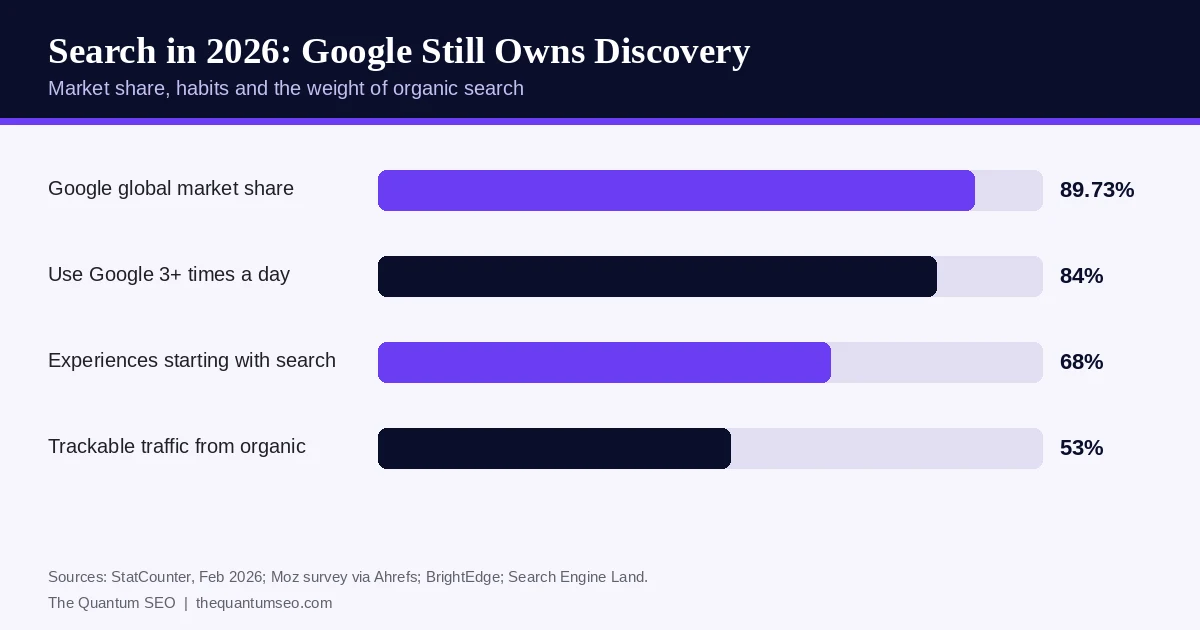
1. About 68% of online experiences begin with a search engine. Source: BrightEdge. What it means: search is still the front door of the web, even in the AI era.
2. Google holds 90.39% of global search engine market share across all devices. Source: StatCounter, reported by Ahrefs, 2026.
3. Bing holds about 5.13% of global search share, followed by Yahoo at about 1.48%, Yandex at about 1.3% and DuckDuckGo at about 0.75%. Source: StatCounter, reported by SeoProfy.
4. Google accounts for 63.41% of all US web traffic referrals. Source: SparkToro.
5. Organic search drives about 53% of all website traffic, and SEO drives over 1,000% more traffic than organic social media. Source: BrightEdge.
6. Google processes more than 5 trillion searches every year. Source: Google, reported by Search Engine Land.
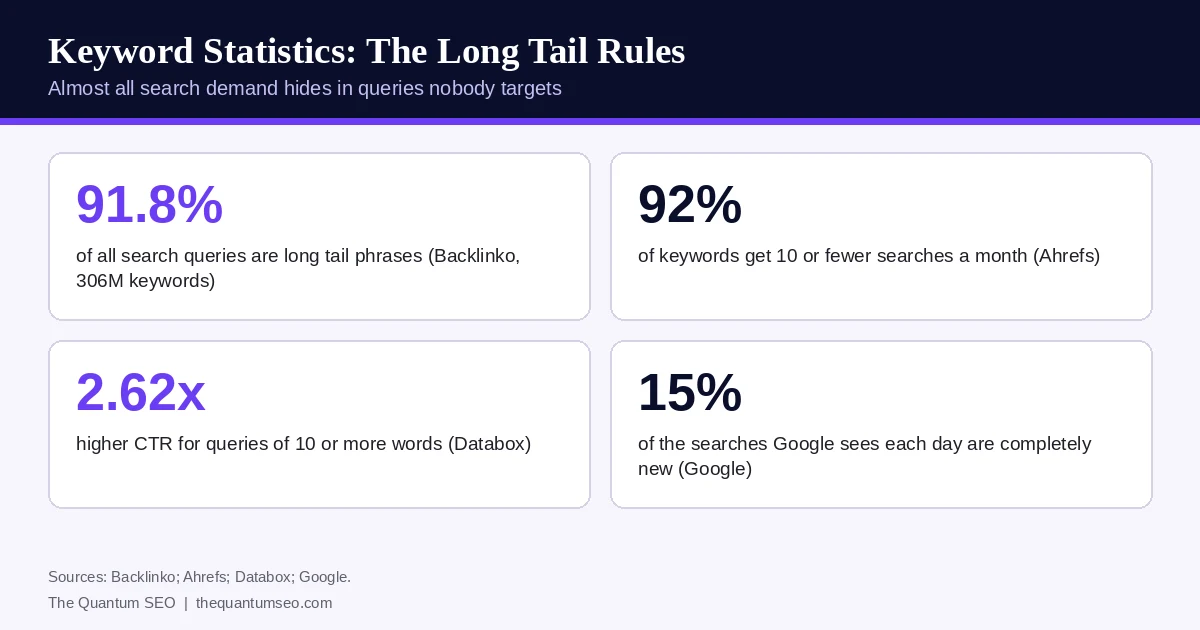
7. About 15% of all Google searches have never been searched before. Source: Google. What it means: keyword tools can never show you the whole demand picture.
8. About 80.3% of internet users used a search engine in the past month. Source: DataReportal.
9. Google maintains a web index of roughly 400 billion documents. Source: Zyppy.
10. The average Google user makes about 4.2 searches a day, while the median user is closer to 1.8. Source: Exploding Topics data, reported by SeoProfy.
11. More than 1.5 billion people use Google Lens every month, and Google passed 100 billion visual searches by 2025. Source: Think with Google.
12. Search still sends 91.66% of referral traffic, while AI chatbots send 0.25%. Source: StatCounter, reported by BlazeHive, 2026.
2. AI search and AI Overview statistics
1. 87% of marketers surveyed use AI to create or help create content, based on 769 of 879 respondents. Source: Ahrefs.
2. About 74% of all new web content now contains AI generated material. Source: Ahrefs.
3. 56% of companies say they already use AI in digital marketing, while 44% are waiting for more stable and proven tools. Source: SurveyMonkey survey, reported by SeoProfy.
4. About 48% of tracked queries triggered an AI Overview in February 2026. Source: Semrush.
5. The share of AI Overview queries that are informational fell from 91.3% in January 2025 to 57.1% in October 2025, while navigational queries rose from 0.74% to 10.33%. Source: Semrush. What it means: AI answers are moving into commercial territory, not staying in simple facts.
6. AI Overviews are associated with a 34.5% drop in organic click through rate. Source: Ahrefs.
7. In a later Ahrefs analysis, an AI Overview was associated with a 58% lower average CTR for the top ranking organic page. Source: Ahrefs.
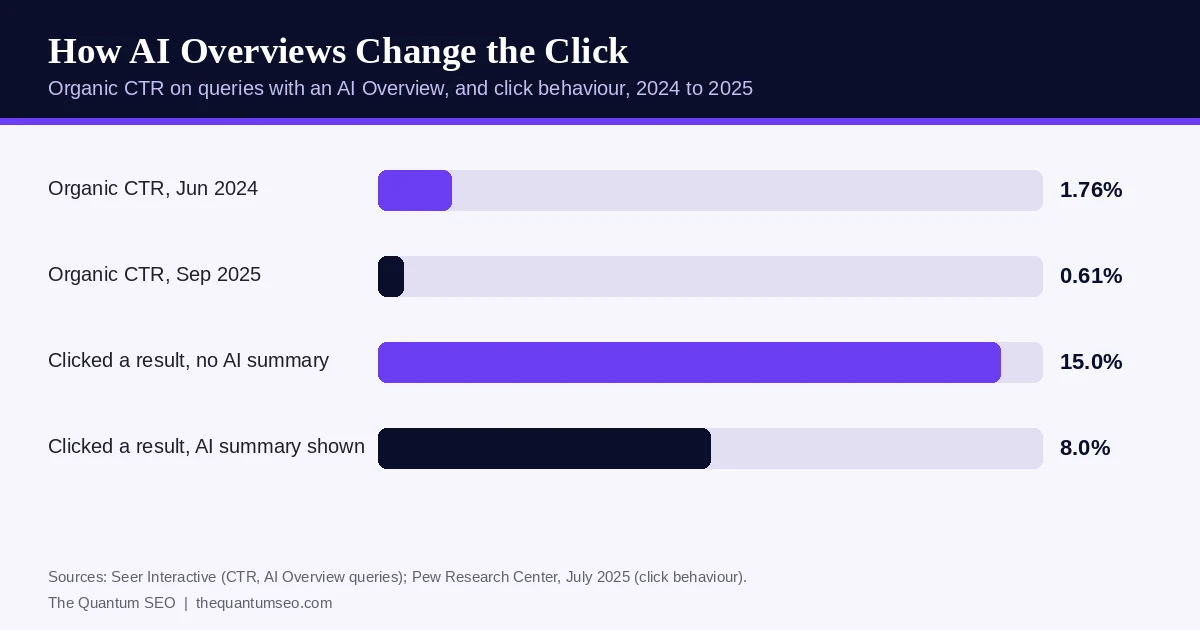
8. Organic CTR on queries with AI Overviews fell from 1.76% in June 2024 to 0.61% in September 2025, a fall of 61%. Source: Seer Interactive.
9. With an AI summary on the page, 8% of users clicked a traditional result, compared with 15% when there was no AI summary. Source: Pew Research Center, July 2025.
10. AI Overviews now reach more than 2.5 billion monthly users. Source: Google, reported by BlazeHive.
11. YouTube accounts for about 23.3% of citations in Google AI Overviews, and Wikipedia for about 18.4%, based on 36 million AI Overviews and 46 million citations. Source: Surfer.
12. ChatGPT accounts for 77.97% of AI referral traffic globally, and Perplexity for 15.10%. Source: SE Ranking.
13. Google still sends 345 times more traffic than ChatGPT, Gemini and Perplexity combined. Source: Ahrefs.
14. Content cited by AI systems is on average 25.7% fresher than content ranking in regular organic results. Source: Ahrefs. What it means: keeping key pages updated is now an AI visibility tactic, not housekeeping.
15. 75% of marketers use AI tools to cut time on manual tasks such as meta descriptions. Source: HubSpot.
16. Companies that use AI in their content process publish about 42% more content each month, at 17 articles against 12 for teams working fully manually. Source: Ahrefs.
17. 48% of the most widely read news sites across ten countries were blocking the OpenAI crawler, and 24% were blocking the Google AI crawler. Source: Reuters Institute.
18. 77.9% of people worry that AI generated answers will reduce clicks to websites. Source: reported by Rank Math.
3. CTR and zero click statistics
1. The first organic result on Google earns about 27.6% of all clicks. Source: Backlinko.
2. A 2026 dataset puts average CTR for position 1 at about 31%. Source: Advanced Web Ranking, 2026.
3. Another widely cited dataset puts the first organic result at 39.8% CTR. Source: First Page Sage. See the reconciliation section above for why these three figures differ.
4. The top 3 organic results receive 68.7% of all clicks on the page. Source: First Page Sage.
5. A separate 2026 dataset gives the top 3 organic results 54.4% of clicks. Source: Backlinko, 2026.
6. 96.6% of all Google search clicks go to results on the first page. Source: Ahrefs.
7. About 75% of users never scroll past the first page of results. Source: reported by OuterBox and other roundups.
8. Only about 9% of users scroll to the bottom of the first page. Source: Backlinko.
9. 68.01% of US Google searches ended without a click to the open web between January and April 2026. Source: SparkToro and Similarweb.
10. Only 232 of every 1,000 US Google searches reach the open web. Source: SparkToro and Similarweb data, reported by BlazeHive.
11. 61.5% of desktop searches and 34.4% of mobile searches result in no clicks in the SparkToro clickstream dataset. Source: SparkToro.
12. Moving up one position in Google can raise relative CTR by about 32.3%. Source: Backlinko.
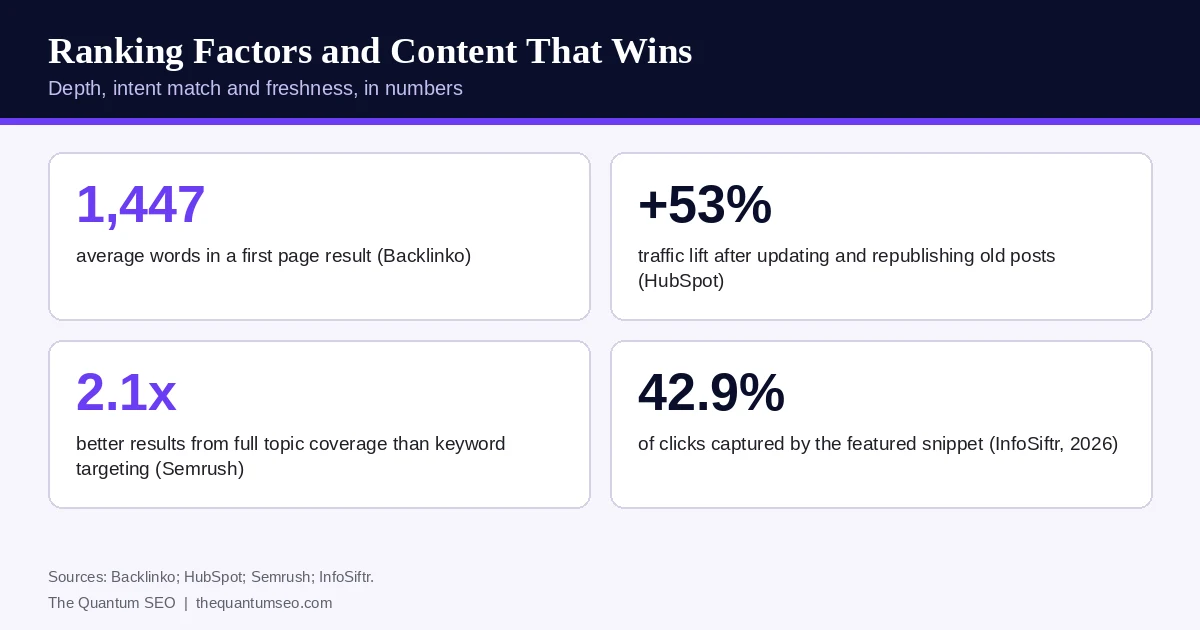
13. Featured snippets earn a CTR of about 42.9%. Source: Ahrefs, 2025.
14. Rich results take about 58% of clicks, compared with about 41% for standard results. Source: Search Engine Journal, 2025.
15. About 65% of people who search on Google click an organic result at some point in their session. Source: Backlinko, reported by SeoProfy.
4. Ranking and content statistics
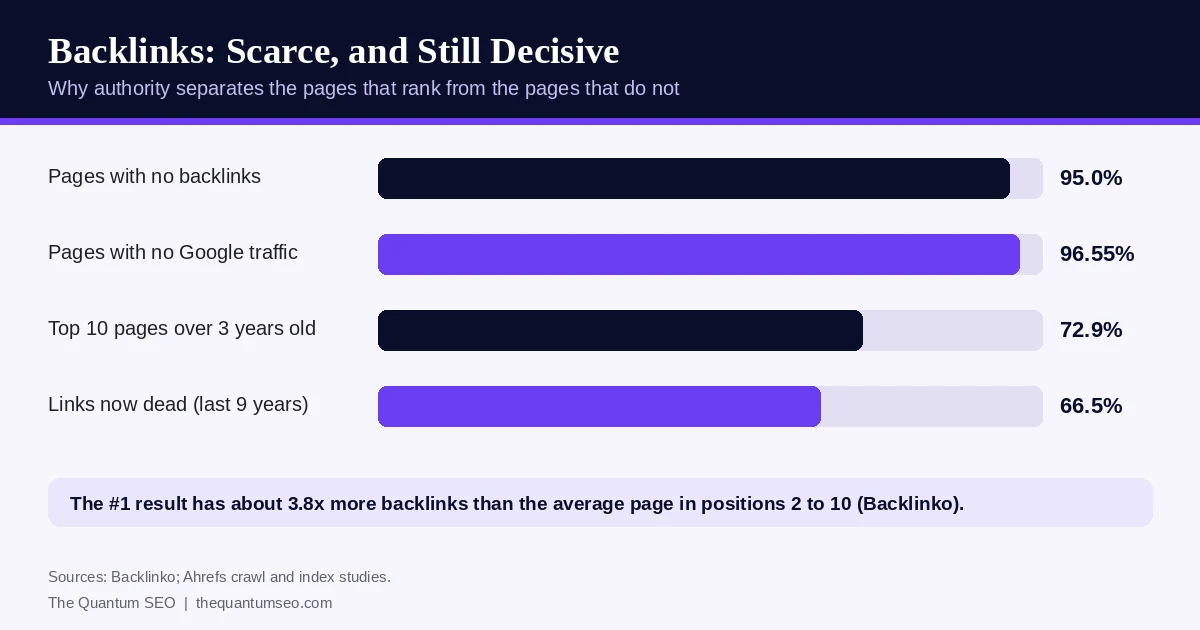
1. 96.55% of all pages get zero search traffic from Google. Source: Ahrefs.
2. Only 1.94% of pages get between one and ten monthly search visits. Source: Ahrefs.
3. Only 1.74% of newly published pages reach the top 10 within one year for at least one keyword. Source: Ahrefs.
4. 72.9% of pages ranking in the top 10 are more than 3 years old. Source: Ahrefs. What it means: age alone does not rank a page, but durable pages that keep earning links and updates dominate.
5. The top ranking page receives the most search traffic only 49% of the time. Source: Ahrefs.
6. The average top ranking page also ranks in the top 10 for nearly 1,000 other relevant keywords. Source: Ahrefs.
7. The average first page result contains about 1,447 words. Source: Backlinko.
8. The average blog post in 2025 was about 1,333 words long. Source: Orbit Media Studios.
9. Content of more than 3,000 words generates about 77.2% more backlinks than content under 1,000 words. Source: IncRev data, reported by Backlinko and SeoProfy.
10. There is no correlation between Flesch Reading Ease scores and ranking position. Source: Ahrefs.
11. 7.4% of top ranking pages have no title tag. Source: Ahrefs.
12. Google rewrites title tags 33.4% of the time in the most recent Ahrefs measurement, and is 57% more likely to rewrite titles that are too long. Source: Ahrefs.
13. 25.02% of top ranking pages have no meta description. Source: Ahrefs.
14. Google rewrites meta descriptions 62.78% of the time, and shows the written meta description only 37.22% of the time. Source: Ahrefs.
15. 30.9% of featured snippets rank in position 1. Source: Ahrefs.
16. 70% of internet users prefer to learn about a company through articles rather than adverts. Source: Hostinger data, reported by SeoProfy.
17. 65% of respondents in one survey said human written content is better quality than AI generated content, 14% said AI content was better, and 21% said they were about the same. Source: Ahrefs.
5. Backlink statistics
1. The number 1 result in Google has on average about 3.8 times more backlinks than results in positions 2 to 10. Source: Backlinko.
2. About 94% to 95% of all pages have no backlinks at all. Source: Backlinko.
3. Only about 2.2% of content earns links from more than one website. Source: Ahrefs Content Explorer data, reported by SeoProfy.
4. Top ranking pages gain followed backlinks from new referring domains at a pace of about 5% to 14.5% per month. Source: Ahrefs.
5. There is a clear positive correlation between the number of websites linking to a page and the search traffic that page receives. Source: Ahrefs.
6. 73.6% of domains have reciprocal links, meaning some sites they link to also link back to them. Source: Ahrefs.
7. 43.7% of top ranking pages have some reciprocal links. Source: Ahrefs.
8. 66.5% of links created in the last nine years are now dead. Source: Ahrefs. What it means: link profiles decay, so link earning cannot be a one time project.
9. 10.6% of backlinks to the top 110,000 sites are nofollow, 0.44% use the ugc attribute and 0.01% use sponsored. Source: Ahrefs.
10. Pages with at least one exact match anchor from internal links received at least five times more traffic than pages without one in the Zyppy study. Source: Zyppy.
11. SEOs typically take one to two hours to build a single link. Source: Aira.
12. 92% of marketing specialists say link building will remain a key ranking factor over the next five years. Source: SearchLogistics survey, reported by SeoProfy.
13. 44.02% of surveyed companies keep link building in house. Source: Editorial Link survey.
6. Keyword statistics
1. 94.74% of keywords get ten or fewer monthly searches. Source: Ahrefs.
2. Only 0.0008% of keywords get more than 100,000 monthly searches. Source: Ahrefs.
3. Google Ads Keyword Planner overestimates search volume 54.28% of the time, and is roughly accurate 45.22% of the time. Source: Ahrefs.
4. 46.08% of clicks in Google Search Console go to terms Google does not show you. Source: Ahrefs.
5. About 50% of searches are four words or longer. Source: reported by OuterBox.
6. Search terms of ten to fifteen words receive 1.76 times more clicks than single word queries. Source: Backlinko.
7. URLs that contain a keyword related word have a 45% higher click through rate than URLs that do not. Source: Backlinko.
8. Brand terms account for about 45.7% of Google searches in the Ahrefs dataset. Source: Ahrefs, reported by SeoProfy.
9. The most searched keyword on Google globally in 2026 was “ChatGPT”, at more than 768 million monthly searches. Source: Ahrefs data, reported by SeoProfy.
10. 38% of webpages published in 2013 were no longer available a decade later. Source: Pew Research Center, May 2024. What it means: long tail demand keeps moving as pages disappear and new questions appear.
7. Technical SEO statistics
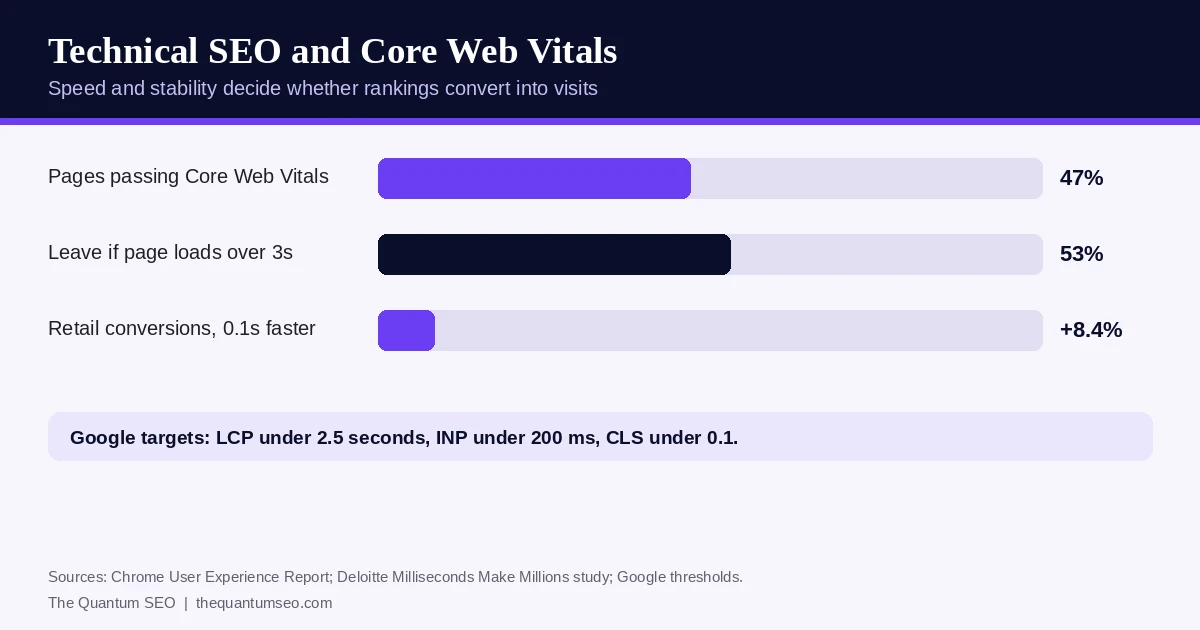
1. Only about 33% of websites pass the Core Web Vitals thresholds. Source: Ahrefs and Chrome UX Report data.
2. 48% of mobile sites passed all three Core Web Vitals in January 2026. Source: HTTP Archive.
3. About 51.8% of source websites met the recommended Core Web Vitals standards in the Chrome dataset. Source: Chrome for Developers data, reported by SeoProfy.
4. 95.2% of sites have 3XX redirect issues. Source: Ahrefs Site Audit data.
5. 88% of sites have HTTP to HTTPS redirect issues. Source: Ahrefs.
6. 72.3% of sites have slow pages. Source: Ahrefs.
7. 59.5% of sites have pages with a missing H1, and 51.3% have pages with multiple H1 tags. Source: Ahrefs.
8. 80.4% of websites have missing alt attributes on images. Source: Ahrefs.
9. 53.1% of home pages have images with missing alternative text. Source: WebAIM Million.
10. More than 67% of domains that use hreflang have hreflang issues. Source: Ahrefs.
11. 66.2% of sites have a page with only one followed internal link pointing to it. Source: Ahrefs.
12. Pages with structured data keep people about 1.5 times longer, and pages enriched with structured data earn roughly 25% more clicks. Source: Google for Developers case data, reported by SeoProfy.
13. 88.5% of survey respondents said slow loading is the top reason visitors leave a website, and 73.1% pointed to poor mobile responsiveness. Source: GoodFirms survey.
8. Local SEO statistics
1. 58% of companies do not optimise for local search at all. Source: ReviewTrackers.
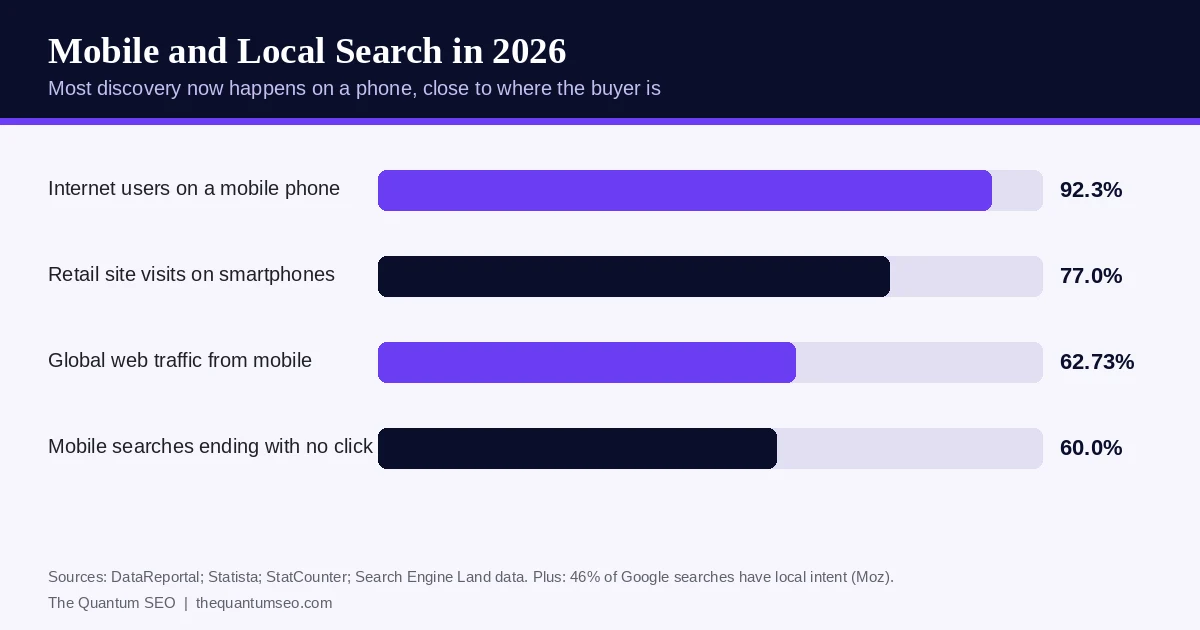
2. 46% of Google searches have local intent. Source: Moz.
3. There are about 1.5 billion “near me” searches every month. Source: Red Local Agency, 2025.
4. 76% of people who search on a smartphone for something nearby visit a business within a day. Source: Google, Think with Google.
5. 28% of searches for something nearby result in a purchase. Source: Google, Think with Google.
6. Customers are 2.7 times more likely to see a business as reputable if it has a complete Google Business Profile, 70% more likely to visit it and 50% more likely to consider buying from it. Source: Google Business Profile support data.
7. Google Business Profile signals account for about 32% of local pack ranking influence, the largest single category in the study. Source: Whitespark.
8. An average Google Business Profile listing receives about 81 actions a month, split roughly into 38% direction requests, 35% website visits and 27% calls. Source: SQ Magazine data, reported by SeoProfy.
9. 80% of consumers say they are likely to use a business that responds to all of its reviews. Source: BrightLocal.
10. 93% of consumers have made a purchase after reading online reviews. Source: BrightLocal.
11. About 42% of consumers regularly read online reviews when searching with local intent. Source: BrightLocal.
12. 45% of consumers now use ChatGPT or other AI tools for local recommendations, up from 6% in the previous study. Source: BrightLocal, February 2026. What it means: local visibility is no longer only about Google Maps. AI tools are becoming a local discovery channel.
13. Local SEO services cost around 1,600 dollars a month for a small business, 5,000 to 8,000 dollars for a growing brand and about 9,500 dollars in highly competitive markets, according to one agency pricing dataset. Source: SeoProfy agency data. Treat this as an agency reported range, not a market wide average.
9. Mobile SEO statistics
1. Mobile devices account for 62.73% of global website traffic. Source: Statista.
2. 92.3% of internet users access the web using a mobile phone. Source: DataReportal data, reported by Rank Math.
3. Google holds more than 95.2% of the global mobile search market. Source: StatCounter.
4. Smartphones accounted for 77% of retail site visits in the third quarter of 2025. Source: Statista.
5. Almost 60% of Google mobile searches now end without a click. Source: Search Engine Land data, reported by SeoProfy.
6. 51% of smartphone users discovered a new company or product while searching on their phone. Source: Google.
7. 56% of in store shoppers used a smartphone to shop or research while in the store. Source: Google.
8. Mobile accounted for 51.04% of global platform market share in May 2026, a different measure from traffic share, which is why mobile figures vary between reports. Source: StatCounter platform data, reported by Ahrefs.
10. Voice search statistics
1. The average voice search result is only 29 words long. Source: Backlinko.
2. Pages that rank for voice search load in about 4.6 seconds on average. Source: Backlinko.
3. About 75% of voice search answers come from a page that ranks in the top 3 for that query. Source: Backlinko.
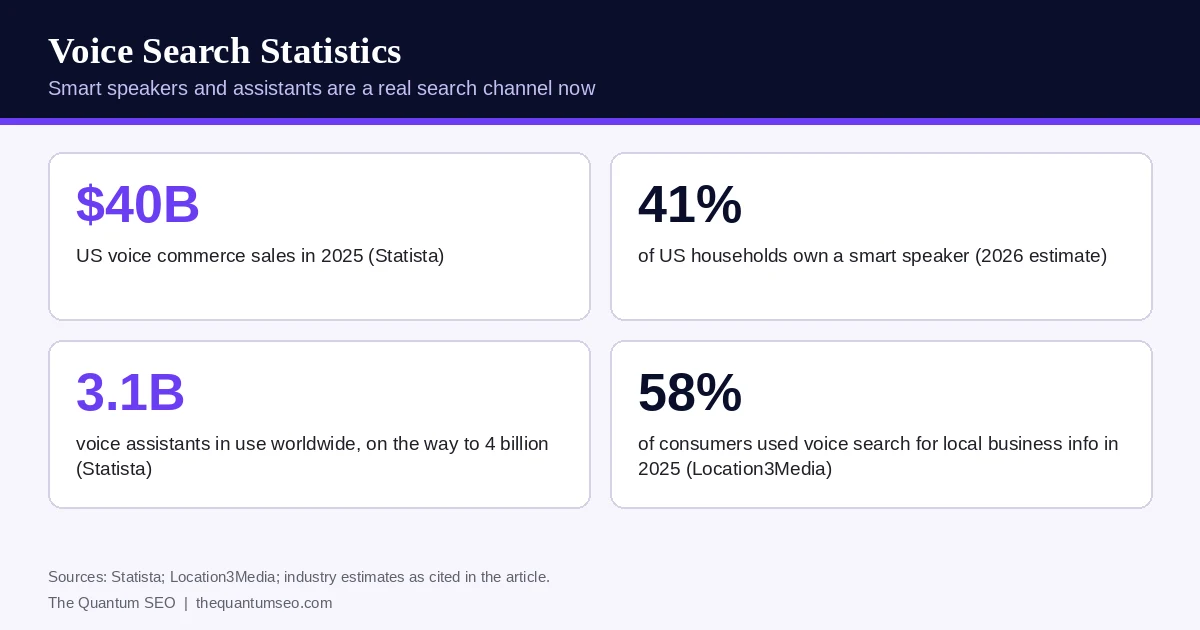
4. Voice assistant users in the United States are forecast to reach 157 million in 2026, up from 142 million in 2022. Source: Statista.
5. About 100 million people in the United States, roughly 35% of those aged 12 and over, own a smart speaker. Source: Edison Research data, reported by Scoop Market.
6. About 32% of consumers say they use voice search daily instead of typing. Source: DigitalSilk data, reported by SeoProfy.
7. In 2025 the United States had about 92.4 million Google Assistant users, 87 million Siri users and 77.6 million Alexa users. Source: eMarketer.
8. Voice search results load about 52% faster than an average web page. Source: DemandSage data, reported by SeoProfy.
9. 73.7% of marketers plan to maintain or increase their investment in voice search optimisation in 2026. Source: HubSpot.
11. Video and YouTube SEO statistics
1. 91% of businesses use video as a marketing tool. Source: Wyzowl.
2. 93% of video marketers say video is an important part of their strategy. Source: Wyzowl.
3. 85% of people say a brand video has convinced them to buy a product or service. Source: Wyzowl.
4. 63% of video marketers have used AI video tools to create or edit marketing videos. Source: Wyzowl.
5. 82% of marketers say video has increased traffic to their website. Source: Wyzowl.
6. About 88% of consumers say they are more likely to buy a product after watching a video about it. Source: Zebracat data, reported by SeoProfy.
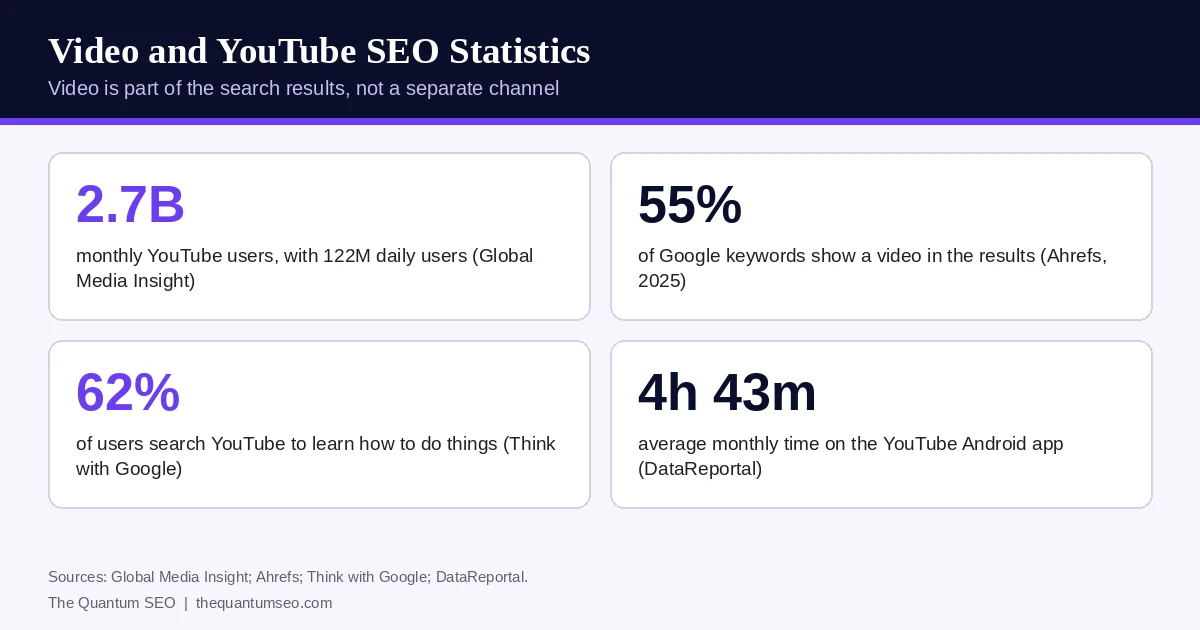
7. YouTube is the second most visited website in the world by organic traffic, at about 2.3 billion visits in March 2026. Source: Ahrefs data, reported by SeoProfy.
8. There are an estimated 5.1 billion videos on YouTube. Source: SEO.AI estimate, reported by SeoProfy.
9. Short form video delivers the highest ROI of any video format for businesses. Source: HubSpot.
10. Use of video captions has risen 572% since 2021. Source: Wistia.
12. Ecommerce SEO statistics
1. Global ecommerce sales are forecast to reach 6.4 trillion dollars in 2026. Source: Shopify.
2. Average ecommerce SEO ROI is only 0.8 times in the first 6 months. Source: First Page Sage.
3. Ecommerce SEO can generate about 5.2 times ROI over a 36 month period. Source: SeoProfy roundup of ecommerce ROI data. What it means: ecommerce SEO looks weak at month 6 and strong at year 3. Judging it on a short window is the most common ecommerce SEO mistake.
4. Ecommerce email marketing shows an average ROI of 4.5 times, against 3.2 times for SEO in the same dataset, which is why mature stores run both. Source: First Page Sage.
5. Smartphones accounted for 71% of total online purchases in the fourth quarter of 2025. Source: Statista.
6. Almost 60% of United States shoppers now use tools such as ChatGPT or Gemini to help them shop. Source: Shopify.
7. In 2025 the average ecommerce brand ranked for 1,783 organic keywords and received about 9,625 monthly organic visits. Source: Reboot Online.
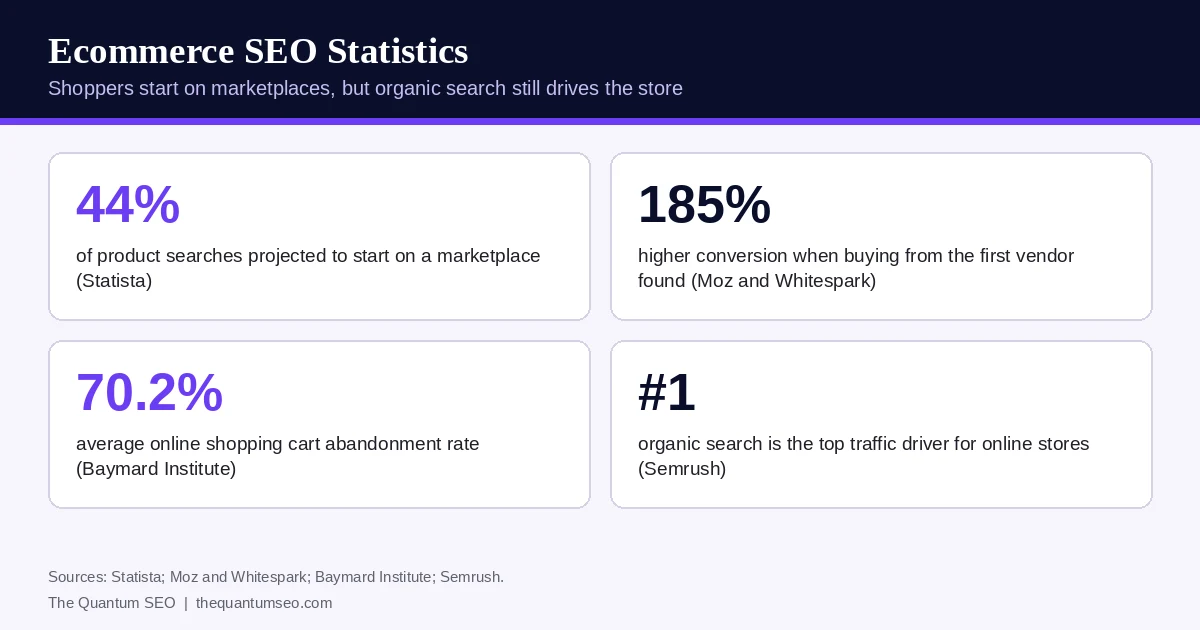
8. 77% of retail site visits come from smartphones, so product and category pages are mobile pages first. Source: Statista.
9. The most visited ecommerce site in the world in 2026 in this dataset was AliExpress, at about 537 million visits. Source: Semrush data, reported by SeoProfy.
13. B2B and professional services SEO statistics
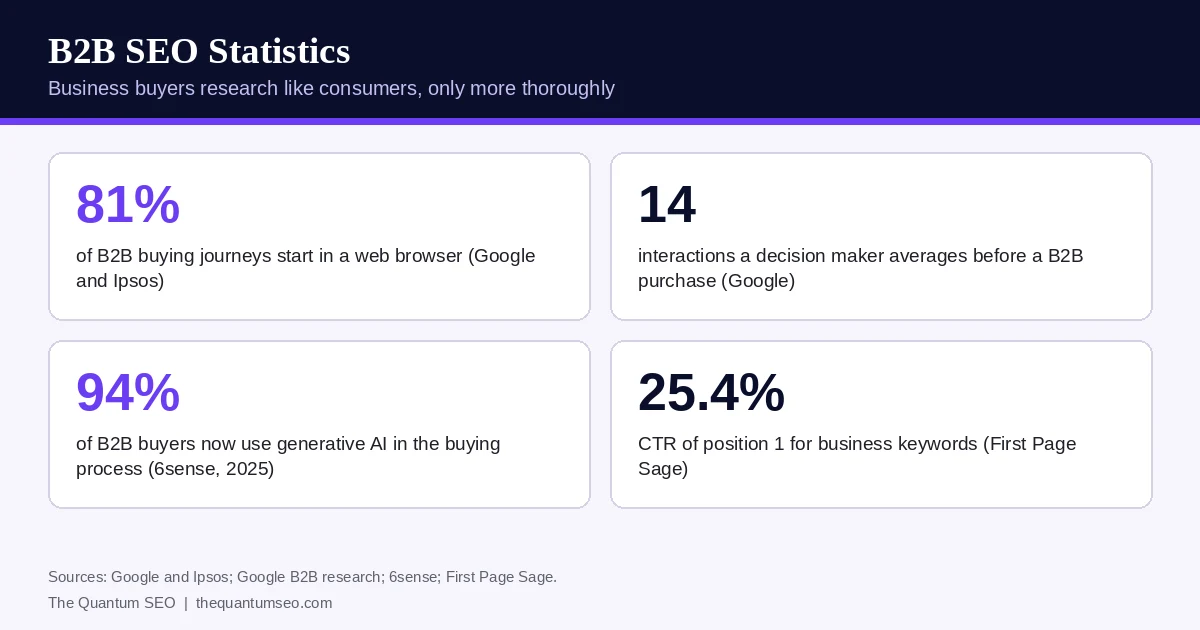
1. About 73% of B2B buyers say they prefer to make purchases online. Source: Sana Commerce.
2. 92% of B2B marketers use short articles and blog posts in their content strategy. Source: Content Marketing Institute.
3. About 66% of B2B buyers in the United States discover products through internet search results. Source: Backlinko.
4. About 79% of B2B marketers consider blog posts an effective way to distribute SEO content and build awareness. Source: DigitalSilk data, reported by SeoProfy.
5. B2B companies publishing nine or more blog posts a month saw a 20.1% yearly rise in Google traffic, against 16.2% for those publishing five to eight times a month. Source: StrataBeat.
6. B2B SaaS businesses that publish original research saw about a 20.9% improvement in top 10 Google rankings. Source: StrataBeat. What it means: original data is the single clearest content advantage in B2B.
7. 77% of patients research symptoms on Google before booking care. Source: Pew Research, 2025, reported by Direction.com.
8. 82% of the most successful B2B content teams say knowing their audience well is the main driver of results, ahead of content quality at 77% and industry expertise at 70%. Source: Content Marketing Institute.
14. SEO industry, pricing and ROI statistics
1. The global SEO market is projected at more than 105 billion dollars by 2026 in one market report, while other 2026 estimates sit near 84 billion dollars. The range reflects different definitions of the market. Source: Mordor Intelligence and Research and Markets estimates, reported by Direction.com and other roundups.
2. United States search advertising revenue reached 114.2 billion dollars in 2025. Source: IAB and PwC.
3. The average Google Ads click cost 5.42 dollars in 2026, up from 2.32 dollars in 2016. Source: WordStream by LocaliQ.
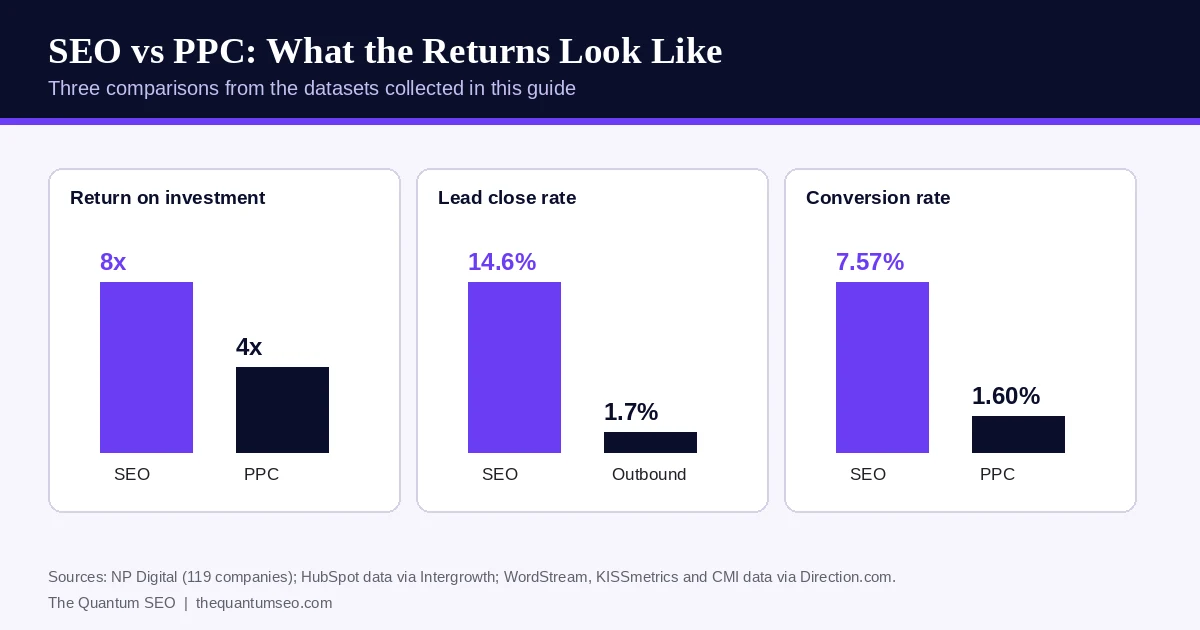
4. SEO leads close at a rate of 14.6%, against 1.7% for outbound leads. Source: HubSpot data, reported by Intergrowth.
5. SEO delivered about 8 times ROI in a study of 119 companies, against about 4 times for PPC. Source: NP Digital data, reported by SeoProfy.
6. In another comparison dataset, SEO converted at 7.57% against 1.60% for PPC, and organic results took 81% of clicks against 19% for paid. Source: WordStream, HubSpot, KISSmetrics and Content Marketing Institute data, reported by Direction.com.
7. SEO campaigns usually reach positive ROI within 6 to 12 months. Source: SeoProfy.
8. 78.2% of SEOs charge a monthly retainer for some or all of their services. Source: Ahrefs pricing survey.
9. The most common monthly retainer is 501 to 1,000 dollars, charged by 20.4% of SEOs. Source: Ahrefs.
10. The most common hourly rate is 75 to 100 dollars, charged by 24% of SEOs, and only 4.1% charge 201 dollars or more per hour. Source: Ahrefs.
11. The most common per project rate is 2,501 to 5,000 dollars, charged by 21.2% of respondents. Source: Ahrefs.
12. SEOs serving a local market charge 1,557 dollars a month on average, while SEOs serving a worldwide market charge 3,474 dollars a month on average. Source: Ahrefs.
13. The median annual SEO salary rose from 49,211 dollars in 2023 to 58,288 dollars in 2024. Self employed SEOs earned the most on average at 60,232 dollars, followed by in house SEOs at 56,789 dollars and agency SEOs at 44,169 dollars. Source: Ahrefs salary survey.
14. SEO service prices commonly range from 25 to 199 dollars an hour, with 150 dollars the most common single rate in one dataset. Source: SeoProfy pricing data.
15. 45% of marketers plan to invest more in SEO and content marketing. Source: Clutch survey, reported by SeoProfy.
Key takeaways: what these statistics mean for your 2026 strategy
1. Rank for clicks, write for citations. Rankings still decide who gets cited. AI systems mostly reuse trusted, well ranked, clearly written sources, so the goal is now double: win the click where clicks still exist, and be the source the AI answer is built from where they do not.
2. Zero click is the default, not the exception. With roughly two thirds of US searches ending without a click to the open web, measuring SEO on sessions alone will understate its value. Track impressions, brand search growth, AI citations and assisted revenue alongside traffic.
3. Freshness is a ranking asset. AI cited content is measurably fresher than regular ranking content. A monthly update cycle for your money pages and statistics pages is now a competitive requirement, not a nice extra.
4. Authority is still scarce, which is why it still works. About 95% of pages have no backlinks and about 97% of pages get no Google traffic. You do not need to beat the whole internet. You need to be clearly better linked and clearly more useful than the small set of pages in your niche.
5. Original data is the only moat left. Every competitor in this space republishes the same third party numbers. The pages that keep winning are the ones that add something only they could publish, such as a survey, a crawl study or real client results.
6. Local and AI search have merged. When 45% of consumers use AI tools for local recommendations, a complete Google Business Profile, consistent citations and review volume are AI visibility work as much as they are map work.
7. Judge SEO on a 12 to 36 month window. Ecommerce and B2B data both show weak returns at 6 months and strong returns at 3 years. Short evaluation windows are the main reason good SEO programmes get cancelled early.
Frequently asked questions
What is the most important SEO statistic in 2026?
The zero click figure. SparkToro and Similarweb found that 68.01% of US Google searches ended without a click to the open web in early 2026. It changes how SEO should be measured, because visibility and citations now carry value even when the user never visits your site.
How many searches does Google process every day?
Google reports more than 5 trillion searches a year, which is roughly 14 billion a day. Daily figures quoted online range from 8.5 billion to 16.4 billion because they are estimates built from that annual total.
What share of website traffic comes from organic search?
About 53% of all website traffic comes from organic search, according to BrightEdge channel data. It remains the largest single source of trackable traffic for most websites.
What is the average CTR of the first result on Google?
There is no single agreed figure. Respected studies report 27.6%, 31% and 39.8%. The difference comes from query type, device, country and whether navigational searches are included. Use the range, and compare your own pages against your own Search Console history.
How many pages get no traffic from Google?
96.55% of pages get no search traffic from Google at all, according to the Ahrefs study. Only 1.94% get between one and ten visits a month.
Do backlinks still matter in 2026?
Yes. The number 1 result has about 3.8 times more backlinks than results in positions 2 to 10, and backlinks also act as a trust filter for AI systems deciding which sources to cite. Quality and relevance matter more than raw volume.
Is SEO still worth it now that AI answers questions directly?
The ROI data says yes. SEO leads close at 14.6% against 1.7% for outbound leads, and one 119 company study found an 8 times return for SEO against 4 times for PPC. What has changed is the measurement, not the value.
How long does SEO take to show a return?
Most datasets put positive ROI at 6 to 12 months. Ecommerce data shows an average return of only 0.8 times at 6 months, rising to about 5.2 times over 36 months.
How big is the SEO industry in 2026?
Estimates range from about 84 billion dollars to more than 105 billion dollars for 2026. The spread comes from scope, since some reports count services only and others add software and in house spend.
Which is better, SEO or PPC?
They do different jobs. In the comparison data collected here, SEO converted at 7.57% against 1.60% for PPC and organic results took 81% of clicks. PPC buys immediate visibility, while SEO builds an asset that keeps producing after the spend stops. Most mature businesses run both.
Download this guide as a PDF: SEO Statistics for 2026 (PDF)
Conclusion
The statistics for 2026 tell one consistent story. Search demand is as large as it has ever been, Google still controls about nine tenths of it, and organic search still drives about half of all website traffic. What has changed is where the value lands. Fewer searches produce a click, AI systems decide which sources to summarise, and freshness, authority and clarity decide who gets chosen.
So the work has not changed as much as the scoreboard has. Publish content that covers a topic completely. Earn links from sites that are themselves trusted. Keep your important pages fast, current and easy to extract an answer from. Then measure visibility, citations and revenue, not clicks alone.
If you want that applied to your own site, start with an honest look at where you stand against the numbers above. The Quantum SEO team can run that analysis for you and show you, in your own Search Console data, which of these statistics is costing you money right now.
Cite this page: Ali Adnan Asim, “SEO Statistics for 2026”, The Quantum SEO, October 2026. If you quote a figure from this page, please link back to it so your readers can check the source and the date.
About the author: Ali Adnan Asim is the founder and SEO Team Lead at The Quantum SEO, with more than 9 years of experience in SEO, AI search visibility and WordPress development for clients in the US, UK and other international markets.
Changelog
– 21 October 2026: First published. All figures checked against their named sources on this date. Conflicting CTR, zero click, search volume and market size figures are shown as ranges with the reason for the difference.
Sources consulted for this article
Google and Think with Google, StatCounter, BrightEdge, SparkToro, Similarweb, Ahrefs studies and surveys, Backlinko, First Page Sage, Advanced Web Ranking, Seer Interactive, Semrush, Pew Research Center, DataReportal, HTTP Archive, Chrome for Developers, WebAIM Million, Whitespark, BrightLocal, ReviewTrackers, Moz, Wyzowl, Wistia, HubSpot, Content Marketing Institute, Clutch, Mordor Intelligence, IAB and PwC, WordStream by LocaliQ, Statista, Shopify, Reboot Online, StrataBeat, Sana Commerce, Reuters Institute, Search Engine Journal, Search Engine Land, Zyppy, Aira, Surfer and SE Ranking. Each statistic in the article names its own source next to the figure.